We're excited to announce that Starforge Robotics has raised $500,000 in pre-seed funding to advance our mission of making capable humanoid robots dramatically more affordable, accessible, and intelligent.
We're building Buildo, an $8,000 open-source humanoid robot designed for developers, researchers, physical AI startups, and eventually real-world deployment. Our goal is simple: make advanced robotics accessible to teams that today are priced out of humanoid development.
But Buildo is not simply an attempt to build a cheaper humanoid.
It is our attempt to rethink where robotic intelligence should live, how it should be delivered, and how developers build on top of it.
The intelligence problem in robotics
The most capable AI models are getting larger.
That is great for intelligence, but it creates a fundamental problem for robotics. Human-level generality increasingly depends on computationally intensive models that are expensive and power-hungry to run directly on a robot. For robotics developers, that creates an uncomfortable tradeoff: run a large model in the cloud and accept high latency, or put expensive GPU compute directly into every machine.
We believe there is another way.
Starforge has been developing a split-inference architecture that allows a large vision-language-action model to run remotely while a lightweight adapter runs at the edge.
The long-term implication is important: robot intelligence no longer has to scale one-to-one with the compute installed inside every robot.
That enables us to pursue much larger intelligence models without turning every humanoid into a mobile GPU cluster.
Meet Buildo
Buildo is the hardware layer of that vision.
The robot is designed around an $8,000 hardware stack, compared with substantially more expensive industrial and research setups. Buildo can carry payloads of up to 18 pounds, has a height adjustable from four to six feet, and supports accessories for collecting egocentric video and tactile data.
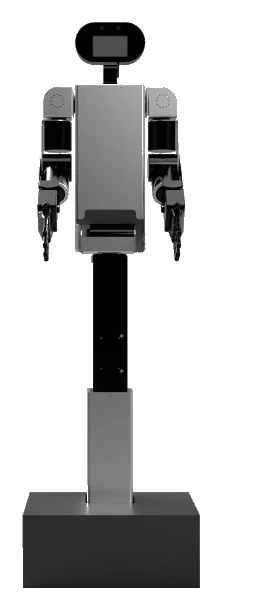
It has 31 degrees of freedom and uses five-fingered dexterous hands, giving developers a platform designed for manipulation rather than simply locomotion or demonstration.
We have also focused heavily on controlling the hardware stack ourselves. More than 80% of Buildo's bill of materials is represented by its actuators and hands, and those components are manufactured in the United States.
The next wave of robotics will not be won by hardware alone. It will be won by the ecosystem that allows thousands of developers to teach robots new capabilities.
From a robot to an intelligence platform
Developers will be able to train skills and distribute those capabilities through a skill ecosystem, with the original developers retaining the entire portion of skill-token revenue.
A researcher should eventually be able to create a manipulation skill, train it, publish it, and allow another robot elsewhere in the world to use it.
As more robots are deployed, more real-world data can be generated. As more developers build skills, the machines become more useful. And as the intelligence layer improves, every compatible robot benefits.
Our ambition is to build the largest open intelligence ecosystem for moving the physical world.
Developers are already building
This isn't just a concept on a whiteboard.
More than 50 developers from universities and startups are already developing on top of Buildo. One early example is Mazout Electric, which is collecting data and training robots for lithium-ion battery manufacturing workflows using the platform.
That developer-first approach is intentional.
Our initial market isn't millions of robots walking through homes. It is the researchers, robotics engineers, universities, and physical AI startups that need affordable hardware today to collect data, train manipulation models, test new ideas, and deploy new robotic skills.
What comes next
This funding gives us the resources to move from prototype and early developer adoption toward production and broader deployment.
And we have built hardware before.
Our founding team brings experience spanning robotics, machine learning, cryptography, embedded systems, aerospace, and mass manufacturing. Founder and Chief Engineer Vipul Saini previously founded Cypherock, while the wider engineering team has experience shipping production machine-learning systems, cryptographic hardware, robotics products, transformer models, and embedded electronics. Starforge is also supported by numerous robotics researchers working on sim-to-real reinforcement learning and high-dexterity manipulation.
The next chapter is about turning that experience into a platform that thousands of builders can use.
Building the physical intelligence ecosystem
AI transformed software because developers no longer needed to build every capability from scratch.
We believe robotics is approaching the same transition.
The winning robot may not be the machine with the most compute inside it. It may be the machine connected to the largest ecosystem of intelligence, skills, training infrastructure, and real-world data.
That is what we are building at Starforge Robotics.
A capable humanoid. An open developer platform. And an intelligence layer designed to get better every time the ecosystem builds on top of it.
The $500,000 pre-seed round is an important step toward that future.
And we're just getting started.