Today, most of the time and money in rocket infrastructure goes into learning through real-world launch attempts. Every test, every failure, every iteration exists just to make the system 1% better.
What happens when that entire learning loop gets automated?
The Context Problem — and Why AI Wins It
Humans are remarkably bad at one thing: holding vast, interconnected context in mind simultaneously. A rocket program spans hundreds of thousands of components, millions of design decisions, years of test data, and teams spread across continents. No engineer — however brilliant — can hold all of that at once.
AI can.
The ability to reason across enormous context is where AI fundamentally outperforms human cognition. In space infrastructure, this isn’t a nice-to-have. It’s the unlock. An AI system that can ingest every simulation run, every failure mode, every material property, and every environmental variable — and iterate on all of it simultaneously — compresses years of the traditional development cycle into weeks.
The Moon Race Is Back. It’s Different This Time.
The race to the lunar south pole isn’t just about being first to arrive. It’s about who captures it.
In the 1960s, the best we could do was land astronauts, plant a flag, and collect samples. That was the full extent of what human presence in space could achieve at the time. The hardware was too expensive, too fragile, and too dependent on humans in the loop to do anything more.
This time, we have Physical AI.
The nations and companies that deploy autonomous robotic systems on the lunar surface first will be the ones that establish permanent, self-sustaining operations. They will mine water ice. They will build infrastructure. They will create the forward base for everything that comes after — Mars, the asteroid belt, the outer planets.
A flag lasts a few decades. Infrastructure lasts forever.
Orbital Data Centres: The Next Frontier That Needs a Launch Stack
The demand for AI compute is growing faster than Earth-based data centres can absorb it. The next logical step is orbital infrastructure — compute platforms in low Earth orbit, free from land, power, and thermal constraints.
But putting AI infrastructure into LEO requires a vertically integrated space stack. You need to design the satellite, build the launch vehicle, control the launch cadence, and manage the orbital operations — all under one roof. The companies that own their launch infrastructure will be the ones that make orbital compute economically feasible.
The industry needs tens of thousands of rocket systems — not over the next decade, but effectively right now. The gap between demand and launch capacity is already severe. It will only widen.
What We’re Building
We are building Physical AI infrastructure for space manufacturing.
Forge-1 is the first rocket forged by our Physical AI stack — designed, simulated, and built through an autonomous AI-driven process. Its mission: carry a 5 kg payload to low Earth orbit.
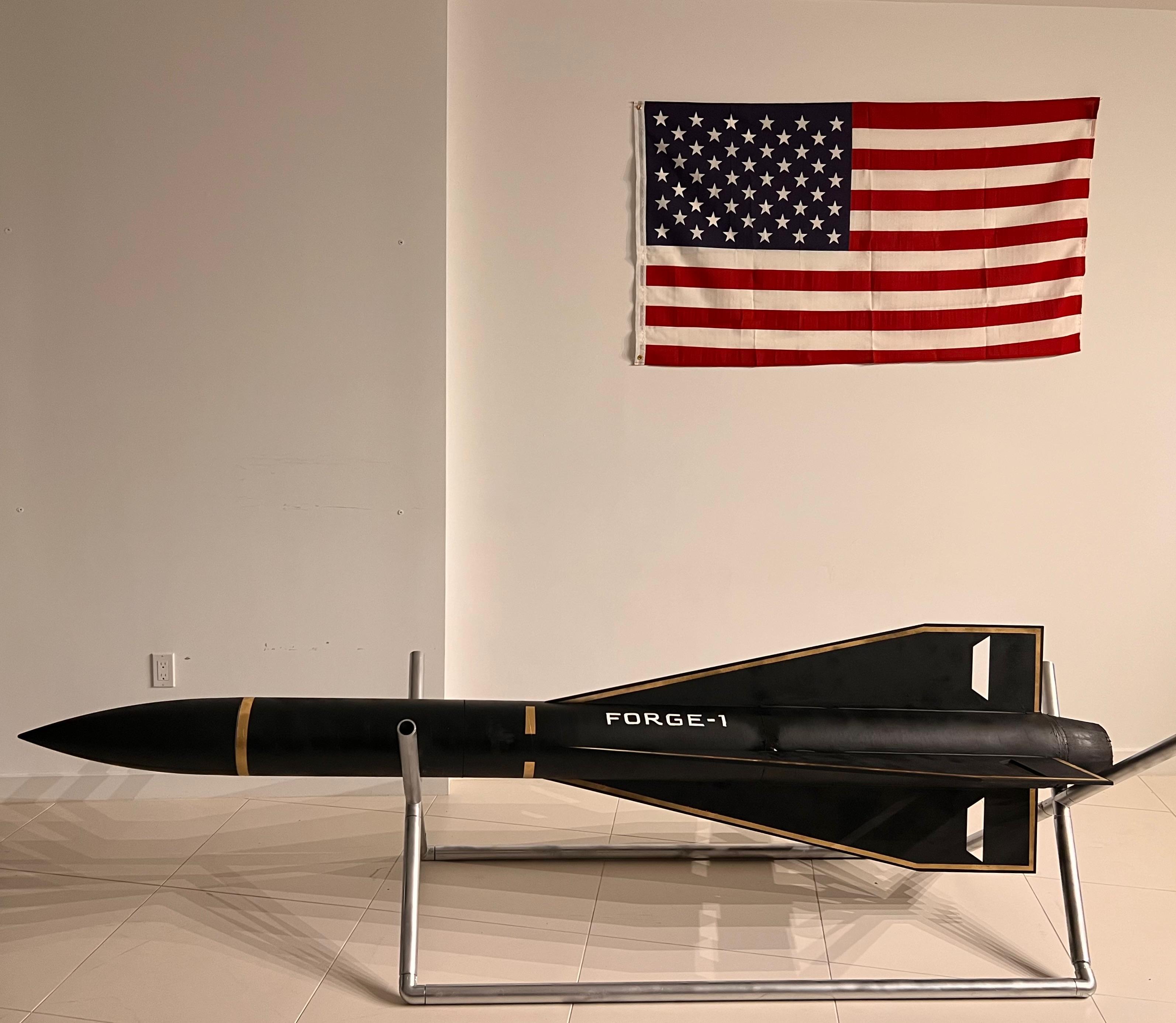
This is just the beginning.
Our Physical AI stack is learning every day. Next up: a hopper test featuring a precision TVC (thrust vector control) system and a highly efficient liquid fuel engine. Every test feeds the loop. Every iteration makes the system sharper.
The learning never stops. That’s the point.
The companies that figure out Physical AI for space won’t just win the next launch contract. They’ll own the infrastructure layer for everything humanity does beyond Earth.
We’re building that layer.