Orbital data centres:
The next frontier that needs launch stack
Companies that own their launch infrastructure will be the ones that make orbital commute economically feasible.
The industry needs 10s of 1000s of reusable rockets — not over the next decade, but effectively right now.
This demand cannot be filled with current rocket development costs and timelines. Starship development alone has already consumed $20 billion.
Physical AI is the key to space
Today most of the time and money in rocket infrastructure goes into learning through real world launch attempts.
Every test, every failure and every iteration exists just to make the system 1% better.
A rocket program spans hundreds of thousands of components, millions of design decisions, years of test data.
Humans are remarkably bad at one thing — holding vast, interconnected context simultaneously.
We have built the Physical AI stack
for Space Infrastructure
Our Physical AI stack can ingest every simulation run, every failure mode, every material property, and every environmental variable — and iterate on all of it simultaneously. This compresses years of development cycles to months.
The stack controls all humanoid robots that can use tools and drive heavy machines — required to build a fully autonomous space infrastructure.
Why us
Putting AI infrastructure in space requires a vertically integrated space tech company.
To train robot AI models we need physical data — we have solved this at scale.
We have the world's best AI model for robot industrial use cases.
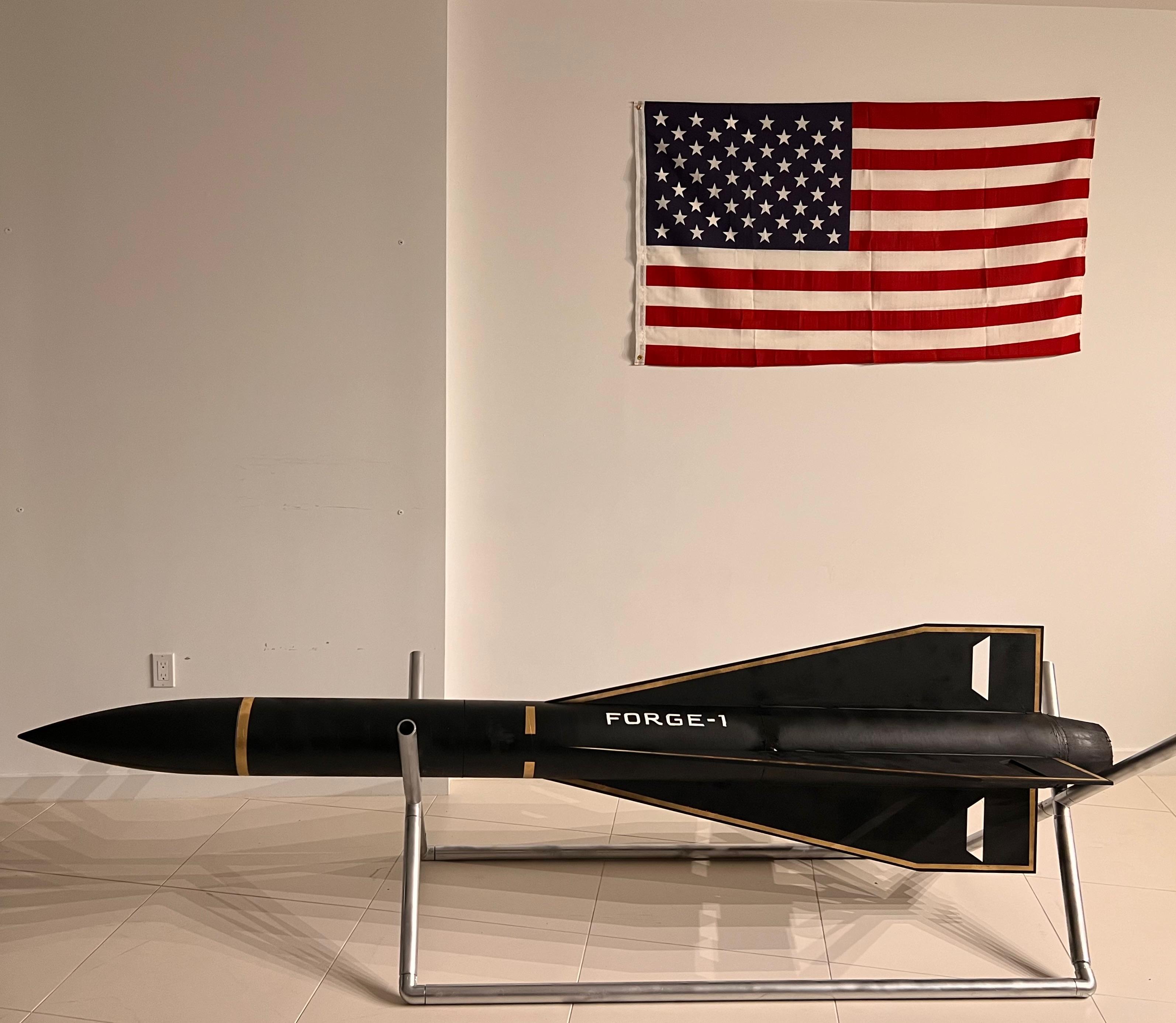
StarForge designed, simulated,
and built a
9-foot VTVL hopper rocket
Built by operators
How we stand better than competition
Starship has consumed $20 billion in development costs. SpaceX cannot reduce payload launch cost significantly without affecting total profit margins — leaving the market wide open.
No company has a physical AI solution deployed for space infrastructure development. We are uniquely positioned as the first mover in this category.
Our vision
Our first product will generate revenue as a rocket launch service provider for deploying orbital data centers in Low Earth Orbit.
SpaceX's launch service business revenue is estimated at approximately $4.1 billion in 2025 — this is our addressable wedge.